What Is Bruxism? Causes & Prevention | PolyMedica Gurgaon
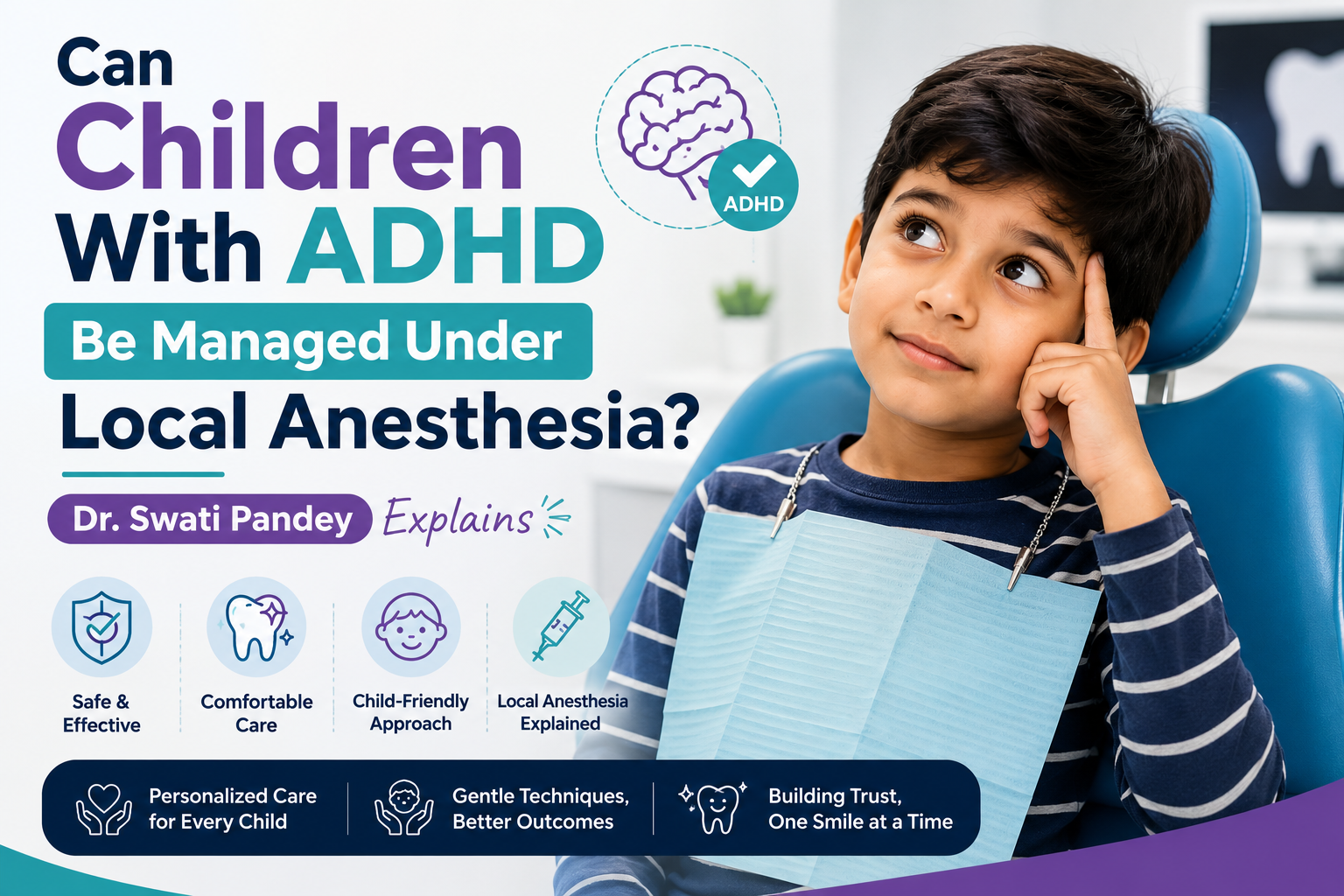
Yes. At Polymedica Dental and Medical Centre, we treat all kinds of patients — including children with special healthcare needs. Children with ADHD (Attention Deficit Hyperactivity Disorder) can absolutely be managed comfortably and safely under local anesthesia, provided the appointment is planned around how that particular child works, not around a standard clinical checklist.
If you are a parent in Gurgaon searching for a dentist who will not rush your child, dismiss your concerns, or hand you a referral the moment things get difficult — this article is for you.
Most parents who walk into our clinic have already had at least one difficult experience elsewhere. The usual concerns sound like this:
These are fair questions. Children with ADHD often have shorter attention spans, higher baseline restlessness, heightened sensory sensitivity to sound and touch, and lower tolerance for waiting. None of these are behavioural “problems” to be corrected — they are simply factors that a paediatric-trained dentist should be planning for in advance.
The good news is that ADHD by itself is not a contraindication to local anesthesia. In the vast majority of cases, general anesthesia is not required.
Before treatment begins, Dr. Swati Pandey spends time understanding the child’s triggers, communication style, medication schedule, and previous dental history. Parents are asked what has worked at home, at school, and at other clinics. This single step prevents most in-chair difficulties.
Many children with ADHD are on stimulant medication with a predictable window of effect. Scheduling the appointment during the period when the child is most settled — often mid-morning — makes an enormous difference. We also avoid long waiting-room time, because waiting is usually harder for these children than the treatment itself.
Instead of one long two-hour session, treatment is often split into shorter visits. A child who leaves after 20 successful minutes returns confident. A child forced through 90 difficult minutes returns terrified. This is the difference between a child who becomes dentally cooperative for life and one who develops lasting dental anxiety.
Every instrument is explained and demonstrated before use. We reduce sensory load wherever possible — dimmed overhead light, headphones or music, sunglasses for light sensitivity, and clear warning before any sound or vibration starts. Positive reinforcement is used consistently throughout.
The injection is the moment most children fear. We use topical numbing gel before the injection, slow-delivery technique, distraction, and the smallest effective needle gauge. Most of our young patients do not identify the moment the injection was given.
This is where clinical training matters. Some ADHD medications can interact with the adrenaline (epinephrine) component present in many local anesthetic solutions. Dr. Swati Pandey reviews the child’s complete medication list and adjusts the choice of anesthetic agent and dosage accordingly, with careful aspiration technique and appropriate monitoring. Parents are always told exactly what is being used and why.
When a child is genuinely unable to cooperate for necessary treatment, conscious sedation or nitrous oxide (laughing gas) is discussed as an option. General anesthesia is reserved for a small minority of cases — extensive treatment needs combined with an inability to cooperate. It is offered as a considered clinical decision, never as a shortcut.
Polymedica Dental and Medical Centre is a multi-specialty dental and medical facility in Gurgaon, offering paediatric dentistry alongside general and specialist care under one roof. Families searching for the best dental clinic in Gurgaon choose us for:
Is local anesthesia safe for a child with ADHD? Yes. ADHD is not a contraindication to local anesthesia. The main consideration is the child’s medication list, which is reviewed before treatment so the appropriate anesthetic agent and dose can be selected.
Will my child need general anesthesia? Usually not. Most children with ADHD complete treatment comfortably under local anesthesia with behaviour management. General anesthesia is considered only when extensive treatment is required and cooperation is not achievable.
Can ADHD medication be taken before a dental appointment? In most cases, yes — and it often helps. Continue the normal schedule unless specifically advised otherwise after your consultation.
How long is each appointment? Typically 20–40 minutes for children with ADHD, deliberately kept shorter and split across visits where needed.
Do you treat children with autism and other special needs? Yes. Polymedica Dental and Medical Centre treats children across the full range of special healthcare needs.
At what age should my child first see a dentist? By the first birthday, or within six months of the first tooth erupting.
If your child has ADHD and dental treatment has been postponed because previous visits did not go well, we would like to change that experience.
WhatsApp us