What Is Bruxism? Causes & Prevention | PolyMedica Gurgaon

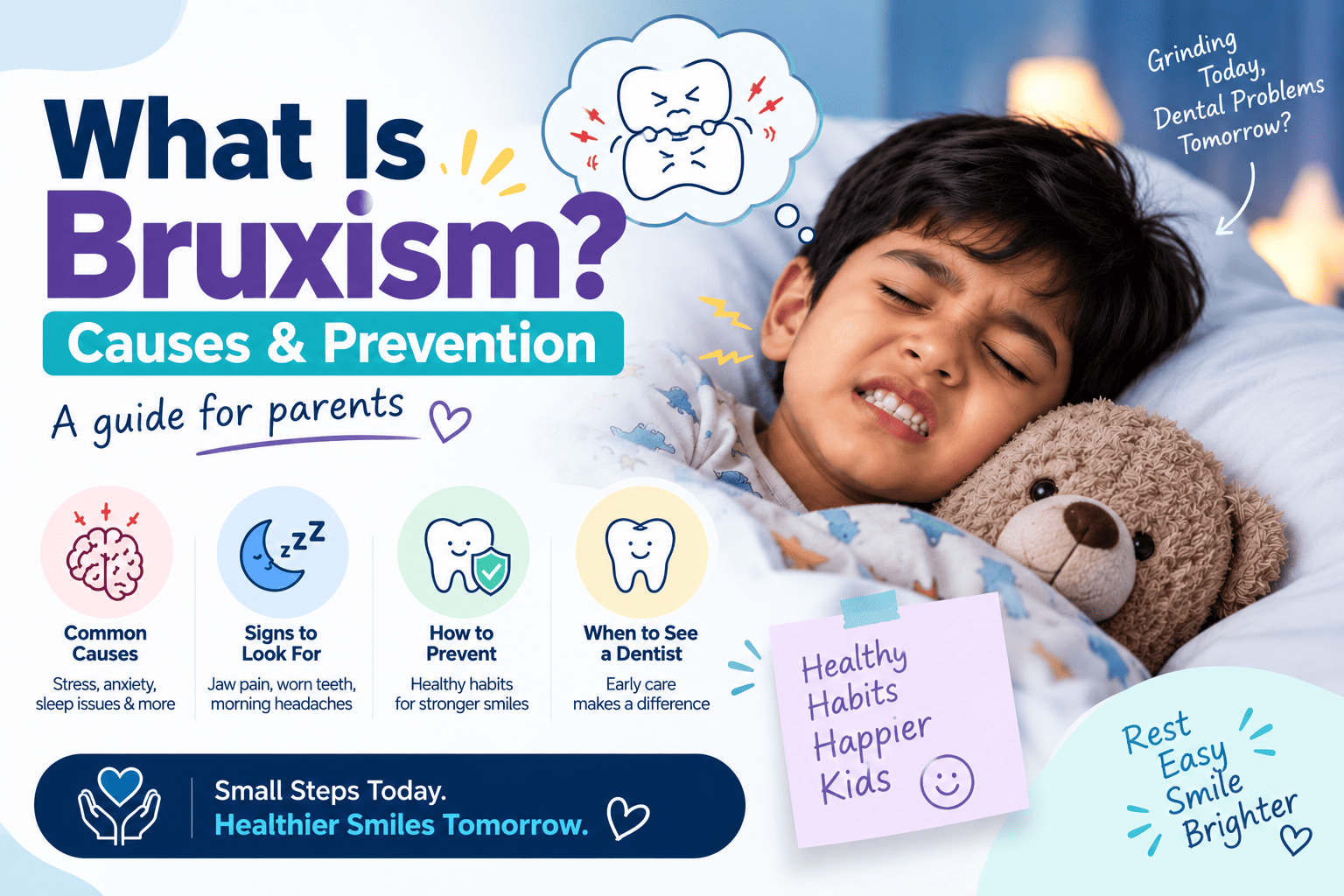
It usually starts the same way. You walk past your child’s room at midnight and hear a sound you can’t quite place: a slow, dry, scraping noise, almost like someone is turning a rusty key. You lean in closer and realise it’s coming from your sleeping child’s mouth.
That sound is bruxism, the medical term for teeth grinding and clenching. And if you’re a parent in Gurgaon lying awake worrying about it right now, here’s the first thing you should know: it is extremely common in young children, and in most cases it is not a sign that something is seriously wrong.
But “common” doesn’t mean “always harmless.” Some children grind hard enough to wear down enamel, crack fillings, or wake up with headaches and sore jaws. The job of a good paediatric dentist is to tell the difference, and that’s exactly what Dr Swati Pandey and the team at PolyMedica Dental and Medical Centre do every week for families across Gurgaon.
Studies of children worldwide put sleep bruxism somewhere between roughly 15% and 40% of kids, depending on the age group and how it’s measured. It shows up most often between ages 3 and 6, and again around ages 9 to 12 when permanent teeth are pushing in.
The reassuring part: a large majority of children simply stop on their own. The grinding tends to fade as the jaw finishes a growth phase and the bite settles.
The part parents miss: a smaller group of children grind for a reason that needs attention, and that reason is often not dental at all.
This is the classic dental explanation. When upper and lower teeth don’t meet evenly (because of crowding, a crossbite, an overbite, or newly erupting teeth sitting slightly high), the jaw muscles keep hunting for a comfortable resting position during sleep. That searching movement is grinding.
You’ll often see this in kids who have just lost a baby molar, or whose permanent front teeth have come in at an odd angle.
This is the one Dr Swati Pandey watches for most carefully, because it is the most under-diagnosed cause of childhood bruxism.
When a child’s airway is partly obstructed at night (by enlarged tonsils or adenoids, chronic allergic rhinitis, a deviated septum, or habitual mouth breathing), the body responds by thrusting the jaw forward to reopen the airway. That jaw movement produces grinding. In this situation, bruxism isn’t the problem; it’s the symptom, and it’s the body’s attempt at a solution.
Given Gurgaon’s air quality through the winter months, allergy-driven nasal blockage and mouth breathing are genuinely frequent findings in the children we see. Look for these clues alongside the grinding:
If several of these are present, the answer is not simply a night guard. It’s a proper airway assessment, and this is where a dental clinic that works alongside medical specialists, as PolyMedica does, makes a real difference.
Children carry stress differently from adults. They may not say “I’m anxious about my exams,” but their jaw muscles will say it for them at 2 a.m.
Common triggers we hear about in clinic: a new school or new class, a shift in the family (a new sibling, a move, a separation), exam pressure, an intense schedule with little downtime, or conflict at home. Screen time close to bedtime and an over-stimulating evening routine also raise night-time muscle activity.
Children grind in response to discomfort they can’t localise. Teething pain in toddlers, an ear infection, a sore throat, a cavity, or an erupting six-year molar can all show up as night grinding. This kind of bruxism is usually short-lived and stops when the underlying pain is treated.
Bruxism sits within a family of sleep behaviours that includes sleepwalking, sleep talking, and night terrors. Children who show one often show another. It is more common in kids with ADHD, autism spectrum disorder, and cerebral palsy, and certain medications, including some stimulants used for ADHD and some SSRIs, can increase grinding as a side effect.
If one or both parents ground their teeth as children, the child is more likely to as well. Genetics won’t change the treatment plan, but it does help explain why some children grind with no other risk factor present.
Caffeine hiding in cola and chocolate late in the day, an irregular bedtime, and a heavy, sugary dinner all raise the odds of a restless, grinding night.
In many Indian households, night grinding is taken as certain proof of worms, and children are given deworming medicine on the strength of that sign alone.
Here’s the honest answer: the scientific evidence linking intestinal parasites to bruxism is weak and inconsistent. A few studies suggest an association; better-designed studies mostly don’t. Grinding on its own is not a reliable indicator of worm infestation.
That said, if your child also has anal itching (particularly at night), a poor appetite, tummy pain, or disturbed sleep with visible discomfort, a paediatric consultation is sensible. What we’d caution against is treating grinding with a deworming tablet and considering the matter closed, because if the real cause is a blocked airway or a bad bite, months go by while enamel wears away.
Book an appointment if you notice any of these:
There is no single fix, because there is no single cause. At PolyMedica, Dr Swati Pandey begins with a full assessment: bite analysis, examination of wear patterns on the teeth, jaw joint check, an airway and breathing history, and a conversation with parents about sleep and stress. Treatment follows from what that assessment finds.
If the cause is the bite: interceptive orthodontics, space maintainers, or minor occlusal adjustment can resolve grinding by giving the jaw a stable position to rest in.
If the cause is the airway: we coordinate with ENT and paediatric colleagues. Treating enlarged adenoids or managing allergic rhinitis often resolves the grinding entirely, with no dental appliance required. Myofunctional therapy to correct tongue posture and restore nasal breathing may also be recommended.
If the cause is stress: a calmer wind-down routine, screens off well before bed, a warm bath, reading together, and a consistent sleep schedule genuinely help. Some children benefit from simple relaxation techniques or, where anxiety is significant, from a child psychologist.
If teeth are already damaged: worn or chipped teeth are restored to protect the underlying structure and prevent sensitivity.
Night guards: a custom-made soft guard can protect teeth from further wear, and we make them when they’re warranted. Two important caveats: a guard protects teeth but doesn’t stop grinding, and because children’s mouths are still growing, guards need regular review and periodic remaking. Over-the-counter “boil-and-bite” guards from a pharmacy are not appropriate for growing children; they fit poorly and can interfere with normal jaw development.
Choosing the right clinic matters more with children than with adults: a child who is frightened at four will avoid the dentist at forty.
Dr Swati Pandey is widely regarded among parents as one of the best kids dentists in Gurgaon, with a practice built around child-specific care rather than adult dentistry scaled down. Families come to PolyMedica for:
If you’ve been hearing that grinding sound at night and wondering whether to worry, the sensible next step is a short assessment. Most children need reassurance and a few habit changes. A few need more, and those are precisely the ones worth catching early.
Book a Consultation PolyMedica Dental and Medical Centre, Dr Swati Pandey, Paediatric Dental Care Address: UG 007 Malibu Market, opp. GoodEarth, Sector 47, Gurugram, Haryana 122018 Phone: 09760763416 | Website: polymedicadental.com Timings: 10:30 A.M. – 8:00 P.M. Searching for the best kids dental clinic in Gurgaon? Call us to book a paediatric dental assessment for your child. |
At what age do children usually stop grinding their teeth?
Most children stop between ages 6 and 13, as the permanent teeth come in and the bite stabilises. Grinding that continues into the teenage years should be evaluated.
Is teeth grinding in children dangerous?
Usually not. Occasional, brief grinding rarely causes lasting harm. Persistent grinding can wear enamel, cause sensitivity and jaw pain, and, when it points to an airway problem, flags something that needs treating.
Does teeth grinding always mean my child has worms?
No. This is a widespread belief, but the evidence connecting intestinal parasites to bruxism is weak. Grinding alone is not a reliable sign of worms.
Should I wake my child when they grind?
No. Waking them disrupts the sleep cycle without stopping the grinding. Note it down and discuss it with your dentist instead.
Can a night guard stop the grinding?
A night guard protects teeth from wear; it doesn’t stop the grinding itself. That’s why identifying the underlying cause matters.
Does my child need X-rays for this?
Not always. Dr Swati Pandey will advise based on the clinical examination, and imaging is only recommended where it will change the treatment plan.
This article is for general information and does not replace an in-person examination. If your child grinds their teeth persistently or shows signs of tooth wear, jaw pain, or disturbed breathing during sleep, please consult a qualified paediatric dentist.
WhatsApp us