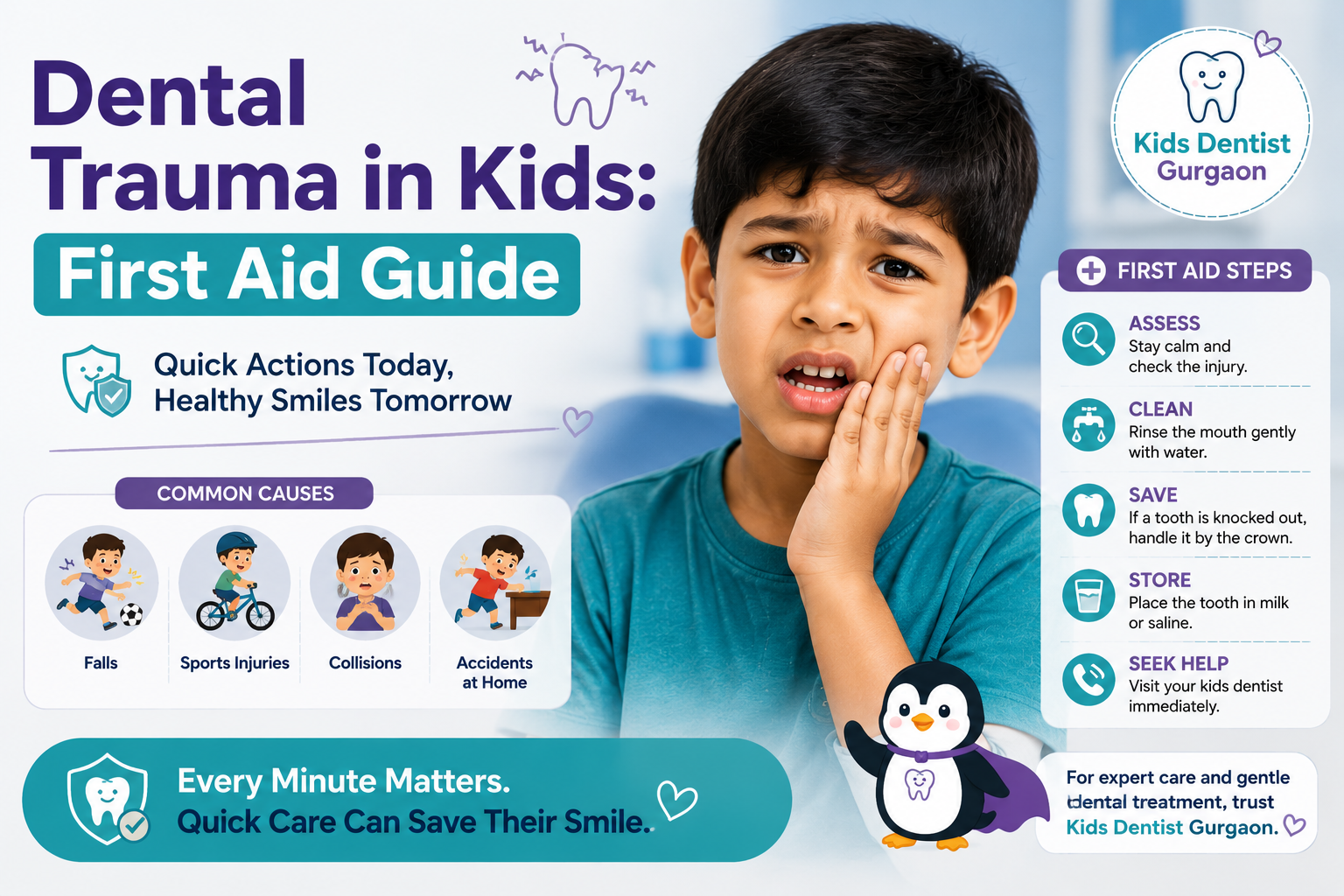
Dental Trauma in Kids: First Aid Guide | Kids Dentist Gurgaon
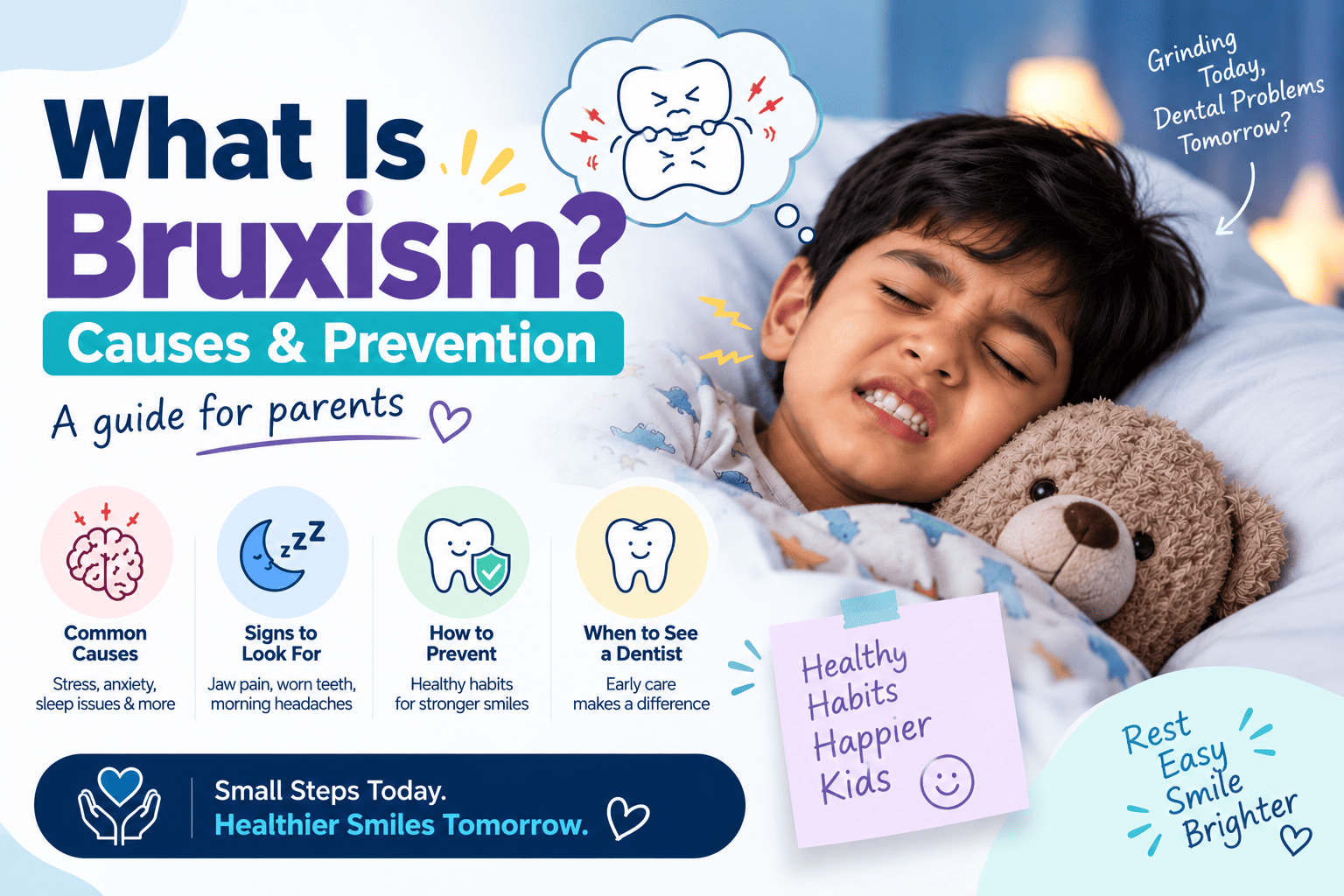
If you’ve ever woken up with a dull ache along your jaw, a headache pressing at your temples, or been told by a partner that you make a grinding noise in your sleep, you’ve likely encountered bruxism. It’s one of the most common conditions dentists see, and also one of the most misunderstood. Most people who grind their teeth don’t know they’re doing it until the damage, or someone else in the room, tells them.
This guide from Dr Swati Pandey at PolyMedica Dental and Medical Centre explains what bruxism actually is, why it happens, and what genuinely helps prevent and manage it, in both adults and children.
Bruxism is the repeated, involuntary grinding, gnashing, or clenching of teeth, either during sleep or while awake. It’s classified into two types, and the distinction matters because they’re driven by different mechanisms:
Sleep bruxism happens during sleep and is now understood as a sleep-related movement disorder, closely linked to brief arousals in the sleep cycle. It’s involuntary and usually the more damaging of the two, since the clenching force during sleep can be far greater than what a person would ever tolerate while awake.
Awake bruxism happens during the day, usually as clenching rather than grinding, and tends to show up during concentration, stress, or deep focus, at a desk, in traffic, scrolling a phone. Many people don’t realise they’re doing it until they notice jaw tightness.
Bruxism affects both children and adults. Estimates suggest around 8 to 10% of the adult population and up to 15 to 40% of children experience it at some point, making it far more common than most people assume.
Because sleep bruxism happens unconsciously, most people find out from someone else, or from their dentist. Watch for:
If several of these sound familiar, it’s worth a dental check, even if you’ve never consciously felt yourself grinding.
Bruxism rarely has a single cause. It’s usually the result of one or more of the following, working together.
This is the single most consistently cited trigger in adults. Bruxism often rises during periods of work pressure, financial strain, relationship stress, or major life changes. The jaw becomes an outlet for tension the mind is carrying, often without the person consciously noticing the connection.
Sleep bruxism is closely linked to other sleep disruptions, particularly obstructive sleep apnoea, snoring, and frequent micro-arousals during the night. In these cases, grinding often occurs as the body responds to a partially blocked airway, repositioning the jaw to keep breathing open. This connection is frequently missed, and treating the underlying sleep issue often reduces the grinding significantly.
When the upper and lower teeth don’t meet comfortably, whether from missing teeth, a shifted bite, or dental work that sits slightly high, the jaw muscles work to find a stable resting position. That searching, adjusting movement can manifest as grinding, particularly at night when conscious control is absent.
Several everyday habits measurably increase bruxism risk:
Certain medications list bruxism as a known side effect, most notably SSRIs and SNRIs (common antidepressant classes) and some ADHD stimulant medications. If grinding began or worsened after starting a new medication, it’s worth mentioning to both your doctor and your dentist, rather than stopping the medication on your own.
Bruxism tends to run in families. If a parent ground their teeth as a child or adult, their children have a measurably higher likelihood of doing the same.
Some research links bruxism to particular personality traits, competitiveness, high achievement orientation, and difficulty relaxing or “switching off.” This isn’t a diagnosis, but it’s a pattern dentists notice often.
Occasional, mild grinding usually causes no lasting harm. Persistent, unmanaged bruxism, however, can lead to:
None of this happens overnight, which is exactly why bruxism is easy to ignore until the damage is already visible.
A dentist can usually identify bruxism through a clinical exam alone, checking for characteristic wear patterns on the biting surfaces of the teeth, tenderness in the jaw muscles, and any damage to existing dental work. For more complex cases, particularly where sleep apnoea is suspected, a sleep study (polysomnography) may be recommended to look at what’s actually happening through the night.
There is no single universal fix for bruxism, because there’s no single cause. Effective management usually combines a few of the following, tailored to what’s driving it in each individual.
A custom-fitted night guard, made from an impression of your own teeth, is the most direct way to prevent grinding damage. It won’t stop the grinding itself, but it creates a buffer between the upper and lower teeth, absorbing the force and protecting enamel, fillings, and crowns. Over-the-counter “boil and bite” guards are a poor substitute; they fit loosely, can be uncomfortable enough to affect sleep quality, and don’t distribute force evenly.
Where a misaligned bite is contributing, correcting it, through orthodontic treatment, an adjusted filling or crown, or replacing a missing tooth, can remove the underlying trigger entirely rather than just managing the symptom.
Since stress is the most common driver in adults, addressing it directly often has the biggest impact:
For awake bruxism, simple awareness training helps considerably. Notice when your jaw is clenched during the day, at your desk, while driving, while on your phone, and consciously relax it: lips together, teeth apart, tongue resting gently behind the upper front teeth. Sticky notes or phone reminders can help build the habit until it becomes automatic.
If snoring, daytime fatigue, or witnessed pauses in breathing during sleep are present alongside the grinding, a sleep apnoea evaluation is worth pursuing. Treating the airway issue, sometimes with an oral appliance, sometimes with CPAP therapy, frequently reduces or resolves the grinding as a side benefit.
If bruxism appeared after starting a new medication, your doctor may be able to adjust the dose or switch to an alternative. This should always be discussed with the prescribing doctor rather than changed independently.
Childhood bruxism is usually self-limiting and often resolves as permanent teeth come in and the jaw finishes developing. That said, it’s worth having a dentist check for an underlying cause, particularly a blocked airway from enlarged tonsils or adenoids, which is a frequently missed driver of grinding in kids and responds well to the right treatment once identified.
Book an appointment if you notice:
Early intervention is considerably easier and less expensive than treating enamel loss or a damaged bite after years of unmanaged grinding.
If mornings have been starting with a sore jaw or a dull headache, or someone has mentioned hearing you grind at night, it’s worth having it looked at rather than living with it. Most cases respond well once the right cause is identified.
Book a Consultation PolyMedica Dental and Medical Centre, Dr Swati Pandey Address: UG 007 Malibu Market, opp. GoodEarth, Sector 47, Gurugram, Haryana 122018 Phone: 09760763416 | Timings: 10:30 A.M. – 8:00 P.M. Waking up with jaw pain or headaches? Book a bruxism assessment at PolyMedica Dental and Medical Centre. |
Can bruxism go away on its own?
In children, yes, it very often resolves as the jaw develops and permanent teeth come in. In adults, it’s less likely to resolve without addressing the underlying cause, whether that’s stress, bite alignment, or a sleep disorder.
Is a night guard the same as a mouthguard for sports?
No. A night guard is thinner and designed to absorb grinding forces during sleep, while a sports mouthguard is built to cushion impact. They serve different purposes and shouldn’t be used interchangeably.
Can bruxism be cured completely?
It can often be effectively managed, and in many cases resolved, once the underlying cause, bite, stress, sleep disorder, or medication, is identified and addressed. A night guard protects teeth in the meantime but doesn’t treat the cause on its own.
Does bruxism only happen at night?
No. Awake bruxism, usually clenching rather than grinding, is also common and often tied to concentration or stress during the day.
Is teeth grinding linked to sleep apnoea?
Yes, there’s a well-documented connection. If grinding is accompanied by snoring, gasping, or daytime fatigue, a sleep evaluation is worth discussing with your doctor and dentist.
How long does it take for a night guard to help?
Most people notice reduced jaw soreness and less tooth sensitivity within a few weeks of consistent use, though it protects the teeth from the first night it’s worn.
This article is for general information and does not replace an in-person dental examination. If you experience persistent jaw pain, tooth damage, or suspect a sleep disorder, please consult a qualified dentist or physician.
WhatsApp us