What Is Bruxism? Causes & Prevention | PolyMedica Gurgaon
A follow-up to “Can Children With ADHD Be Managed Under Local Anesthesia?” by Dr. Swati Pandey
In our last article, we answered the question parents ask us most often:
can a child with ADHD be treated safely under local anesthesia? The answer was yes — with the right planning, most children with ADHD complete routine dental treatment comfortably, without needing general anesthesia.
But one successful appointment is not the same as a child who is comfortable at the dentist for life. This article picks up where the last one left off: what happens after that first visit, and how do we turn one good appointment into a lifelong pattern of cooperation?
A single well-managed appointment can undo months of dental avoidance — but it can also be undone by a single bad one. Children with ADHD often form strong, fast associations, and dental memory works the same way. A calm first visit builds trust; a rushed or overwhelming follow-up can reset that trust to zero.
At Polymedica Dental and Medical Centre, we treat every appointment as part of a continuous relationship, not a one-off procedure. That means the second visit is planned with as much care as the first — sometimes more, because expectations are now higher on both sides.
For children with ADHD, we track more than cavities and fillings. We track how each visit went — what triggered restlessness, what calmed the child down, which sensory adjustments worked, and how long real focus lasted before it dropped off. This becomes a working profile that travels with the child from one appointment to the next, so nothing has to be re-learned from scratch every time.
Over several visits, this typically allows us to:
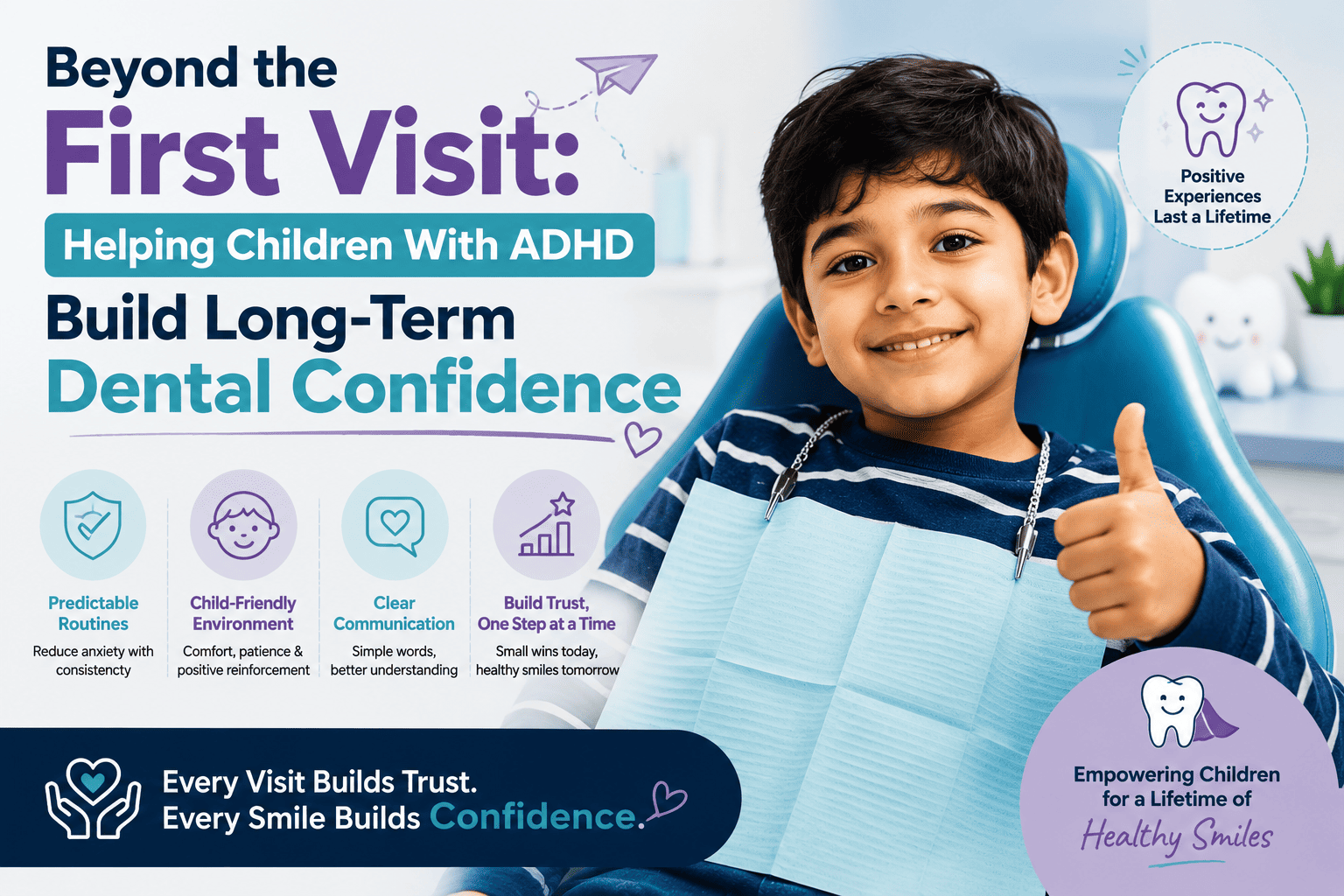
Predictability is one of the most effective tools we have with ADHD children — and one of the easiest to underestimate. Where possible, we try to keep several things consistent across visits:
None of this is incidental. For a child whose brain often struggles with
unpredictability, a dental visit that “feels the same” every time removes one of the biggest sources of pre-appointment anxiety for both the child and the parent.
Our previous article noted that nitrous oxide and conscious sedation are available options, not defaults. As treatment progresses across multiple visits, this is often where families ask a follow-up question: if local anesthesia alone isn’t consistently working, what’s next — and does that mean we’ve failed?
It doesn’t. Some children manage beautifully under local anesthesia from day one. Others need a session or two of nitrous oxide to get comfortable with the environment before local anesthesia alone becomes realistic. A small number need it for every visit involving longer procedures. This is a clinical decision made visit-by-visit, based on the child’s actual response — not a fixed label applied on day one. Dr. Swati Pandey reassesses this at every appointment rather than assuming the previous plan will always apply.
Many children with ADHD are already working with other professionals
With parental consent, this can mean:
Long-term dental comfort is built as much outside the clinic as inside it. Between appointments, we encourage parents to:
The philosophy behind our care hasn’t shifted from the last article: children with ADHD are not harder patients, they are patients who need a plan built around how they work, not around a standard clinical checklist. What extends over time is how precisely that plan gets tailored
Will my child always need the same accommodations, or can that change over time? It usually changes. Many children need fewer sensory adjustments and shorter warm-up periods as visits continue and
trust builds.
What if a previous good visit is followed by a difficult one? This is common and not a sign of failure. Medication timing, sleep, school stress, and sensory overload on a given day can all affect a single appointment. We adjust in the moment and reassess rather than treating it as a setback in the overall plan.
Can my child “graduate” from needing nitrous oxide or extra behavioural support? Yes, in many cases. As cooperation and trust build, some children move toward routine local-anesthesia-only visits over time. This is assessed individually, not assumed.
Should I tell the dentist about therapy or medication changes even if they seem unrelated to teeth? Yes. Medication changes in particular can affect anesthetic choice and how a child responds in the chair, so we always want the current, complete picture.
If your child’s first dental visit with us went well — or if you’re only now considering that first appointment — the goal is the same: a plan that grows with your child, visit after visit, rather than starting over every time.
Book a consultation with Dr. Swati Pandey to discuss a long-term dental care plan for your child.
WhatsApp us